
Unlocking Impact Through Smarter Marine Ingredient Metrics
Date: 27th of November 2025
Time: 14:00–15:00 (GMT)
Location: On-demand webinar
This webinar aims to bring together different viewpoints on the use of marine ingredients, with a focus on how their usage is measured and evaluated.


About the webinar
Maximising sustainable marine nutrition
Sustainable Strategies and Smarter Metrics
A diverse panel of experts working in feed, certification, policy, and academia will share insights and discuss strategies to maximise the nutritional value of marine resources, while ensuring sustainability is maintained.
We’ll explore how FIFO can complement sustainability assessments—such as Life Cycle Assessment (LCA)—and nutrition-sensitive approaches to guide better decision-making. The session will also highlight the importance of using a comprehensive set of metrics—beyond traditional FIFO and FFDR—to better align marine ingredient use with broader food system objectives.
This session is open to industry professionals, policymakers, researchers, and everyone else interested in sustainable food systems, aquaculture, and nutrition.
Join the conversation and help shape the future of marine ingredients in global food systems. Open to all interested in sustainable food systems and aquaculture.
Panel members

Melanie has specialised in seafood for over 20 years working with a portfolio of global organisations on building people and planet positive systems for both wild and farmed seafood. She has become a leading voice on 100% Fish – a term used for full utilisation of seafood to maximise social, economic and environmental benefit.
Named by Intrafish as one of the Women Shaping the Future of Seafood (2025) Melanie is currently leading independent projects, a Director of the Global Seafood Alliance, Chair of Fisheries Innovation & Sustainability, a non-Executive Director of CEFAS, and an Ambassador for the Iceland Ocean Cluster. She was previously an Advisor to the World Economic Forum’s Ocean Program and a Special Adviser to HRH The Prince of Wales’ International Sustainability Unit. Melanie is an Honorary Professor of the Heriot Watt University, Scotland, and holds an MSc in Responsibility & Business Practice (Bath).

Aisla Jones works for the Aquaculture Stewardship Council (ASC). Her focus is on engagement with feed and seafood stakeholders to support the ASC Feed standard and programme. The ASC feed standard takes a holistic approach and feed mills need to demonstrate low risk for legal, social and environmental factors as well as to show continuous improvement of source fisheries. She thinks certification can be a useful tool for supply chains to support responsible feed production, including marine ingredients.

As CEO of Wittaya Aqua, Stephen brings nearly two decades of experience in aquaculture and animal nutrition, with leadership roles in farming, feeds, additive innovation, and technical consulting across Canada, Chile, and the UK. Today, he applies this diverse expertise globally, guiding Wittaya’s efforts to deliver data-driven solutions that enhance feed, ingredient, and animal performance while supporting sustainable aquaculture practices.

Dr Richard Newton is our LCA Specialist and a lecturer in resilient food systems at the Institute of Aquaculture. His work has focused on zero waste strategies to enhance efficiency and economic performance, while reducing environmental impact. Research has included integrating food systems, new technologies and structural innovations throughout aquaculture value chains, from raw material supply to consumption.
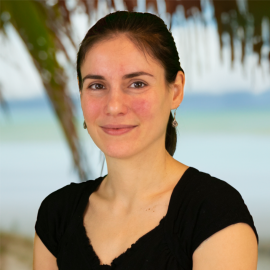
Marine Cusa is a marine researcher with the Technical University of Denmark (DTU Aqua) and a marine policy advisor with Oceana. She specialises in seafood traceability and has a background using genetic tools to improve transparency in the supply chain. As an active Pew Marine Fellow, she will be developing and testing genetic tools to evaluate the composition of fish meal and fish oil and support a more transparent, sustainable aquaculture. Marine has substantial experience in the field, holds a PhD in marine science and has led efforts to bridge the gap between academic methods and real-world applications.
Watch now
Open to all interested in sustainable food systems and aquaculture